
Automated Signing
Sign documents from company side automatically
What Evrotrust Corporate eSign is
Evrotrust Automated Signing enables organizations to apply qualified electronic signatures (QES) or qualified electronic seals (eSeal) to documents automatically, as part of a system-driven business process.
Instead of a person manually opening a document and clicking “Sign” for every instance, automated signing allows your systems to trigger legally relevant signatures via API—once the appropriate authorization and certificates are in place.
The service is designed for high-volume, standardized document flows, where:
- the signer or signing authority is known in advance
- and signing must scale reliably without human interaction per document.
Typical outcomes:
- faster turnaround time;
- reduced operational effort;
- consistent, auditable signing behavior across systems.
Automated Signing is not a generic “background signature engine”. It combines qualified certificates, organizational governance, and technical controls into a single signing model.
Corporate Sign portal for certificate management
The Corporate Sign Portal is the administrative and governance layer of automated signing:
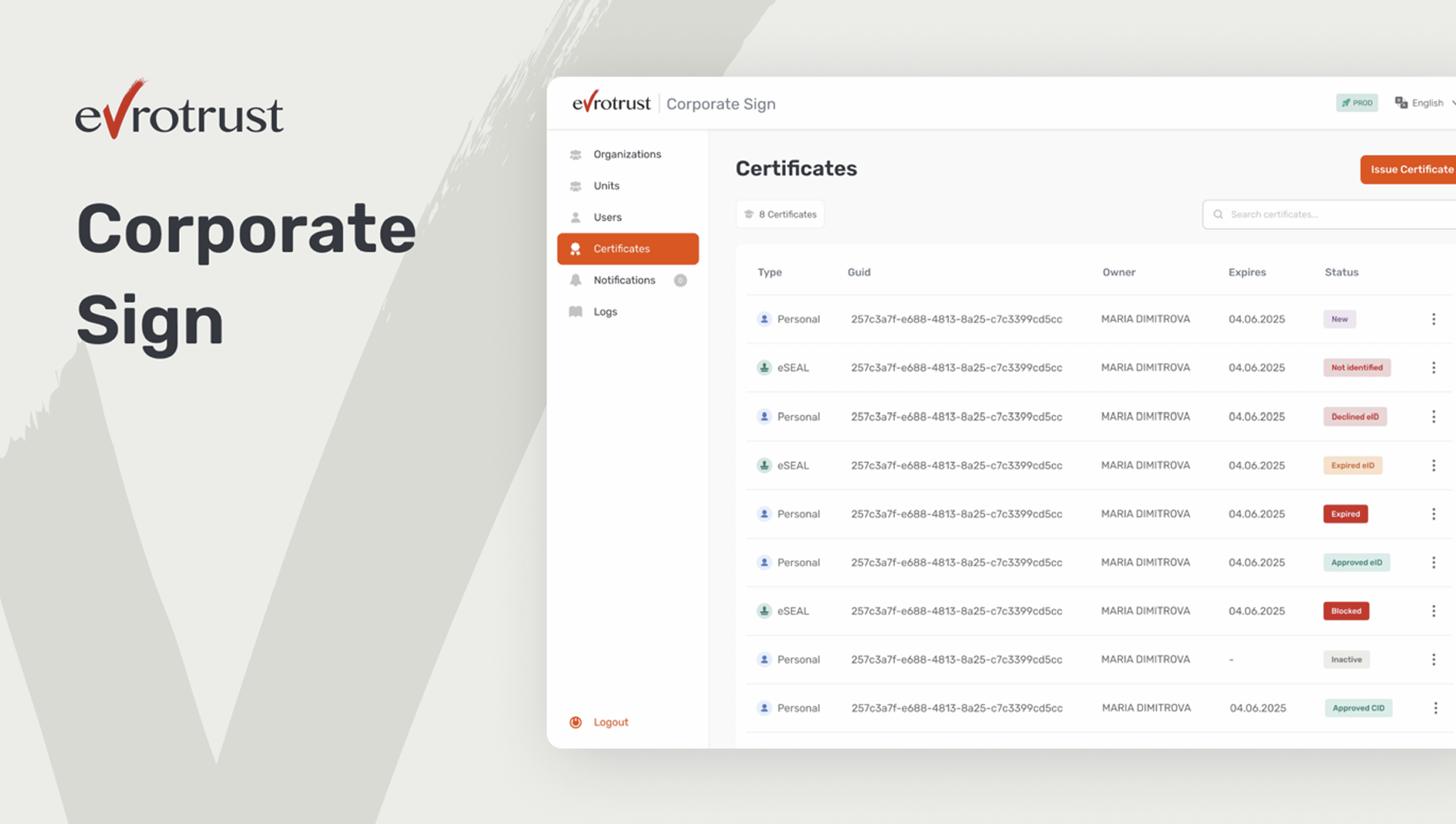
It allows organizations to:
- manage organizational structure and units;
- onboard and manage users and roles;
- issue, activate, block, unblock, and delete certificates;
- monitor certificate lifecycle and notifications.
Security, control, (high level)
Automated signing relies on policy and control, not just cryptography.
At a high level:
- API access is authenticated and authorized
Only permitted systems can submit signing requests. - Certificate state gates signing
Inactive, blocked, expired, or revoked certificates cannot be used. - Explicit lifecycle controls exist
Certificate owners can suspend or deactivate signing capability without touching the integration. - Auditability is built in
Signing operations can be linked to:- the certificate used,
- the signed content,
- timestamps and system context.
This model is designed to support both operational security and post-event analysis (audits, disputes, incident response).
Legal and regulatory positioning (high-level)
Evrotrust Automated Signing is based on qualified trust services and is designed to align with eIDAS-style regulatory frameworks.
Key principles:
- Qualified certificates are issued according to established trust-service processes.
- QES certificates are issued to natural persons and used in a defined representative capacity.
- Automated use is explicit and contractual, not implicit or hidden.
- Control mechanisms (activation, blocking, deactivation) are integral to the service.
- Evidence and traceability are treated as essential, not optional.
Responsibilities and boundaries
To avoid ambiguity:
Client responsibilities
- define who is authorized to sign on behalf of the organization,
- ensure internal mandates and policies are in place,
- control which systems can trigger signing,
- decide when to use QES vs eSeal.
Evrotrust responsibilities
- issue and manage qualified certificates,
- operate the signing infrastructure,
- enforce certificate lifecycle and status,
- provide signing evidence and auditability mechanisms.
In more detail:
| Area | Client | Evrotrust |
|---|---|---|
| Definition of signing authority | Defines who is authorized to sign on behalf of the organization and under which internal mandate or policy | — |
| Choice of signature type | Decides when to use QES vs qualified eSeal based on document type and legal requirements | Provides both qualified signature and seal services |
| User onboarding & identification | Initiates onboarding of representatives and assigns roles in the organization | Performs identification and certificate issuance according to trust-service policy |
| Certificate ownership | Appoints certificate owners and manages internal accountability | Issues and maintains qualified certificates |
| Certificate activation & suspension | Activates, blocks, unblocks, or deactivates certificates via the portal | Enforces certificate state in signing operations |
| API integration | Integrates signing APIs, secures credentials, and controls which systems may trigger signing | Operates signing APIs and backend signing services |
| Signing requests | Ensures signing requests comply with internal policy and approved document scope | Validates certificate status and executes signing |
| Document content & templates | Controls document content, templates, and business context | Does not alter document content |
| Audit & internal controls | Maintains internal logs, approvals, and authorization records | Provides signing evidence, logs, and trust-service records |
| Incident response | Detects misuse or policy violations and suspends signing if needed | Supports investigation and enforces certificate lifecycle actions |
| Legal assessment | Assesses legal effect of automated signatures for specific use cases | Provides trust services in accordance with applicable regulation |
Automated Signing relies on a clear separation between organizational authority (client) and qualified trust services (Evrotrust). Both are required for legally robust operation.
When Automated Signing is the right choice
Automated Signing is a strong fit when:
- signing authority is predefined,
- volume or speed makes manual signing impractical,
- governance and auditability matter.
It is not intended to replace explicit user interaction in scenarios where individual review and consent per document are legally or operationally required.
Updated 6 months ago